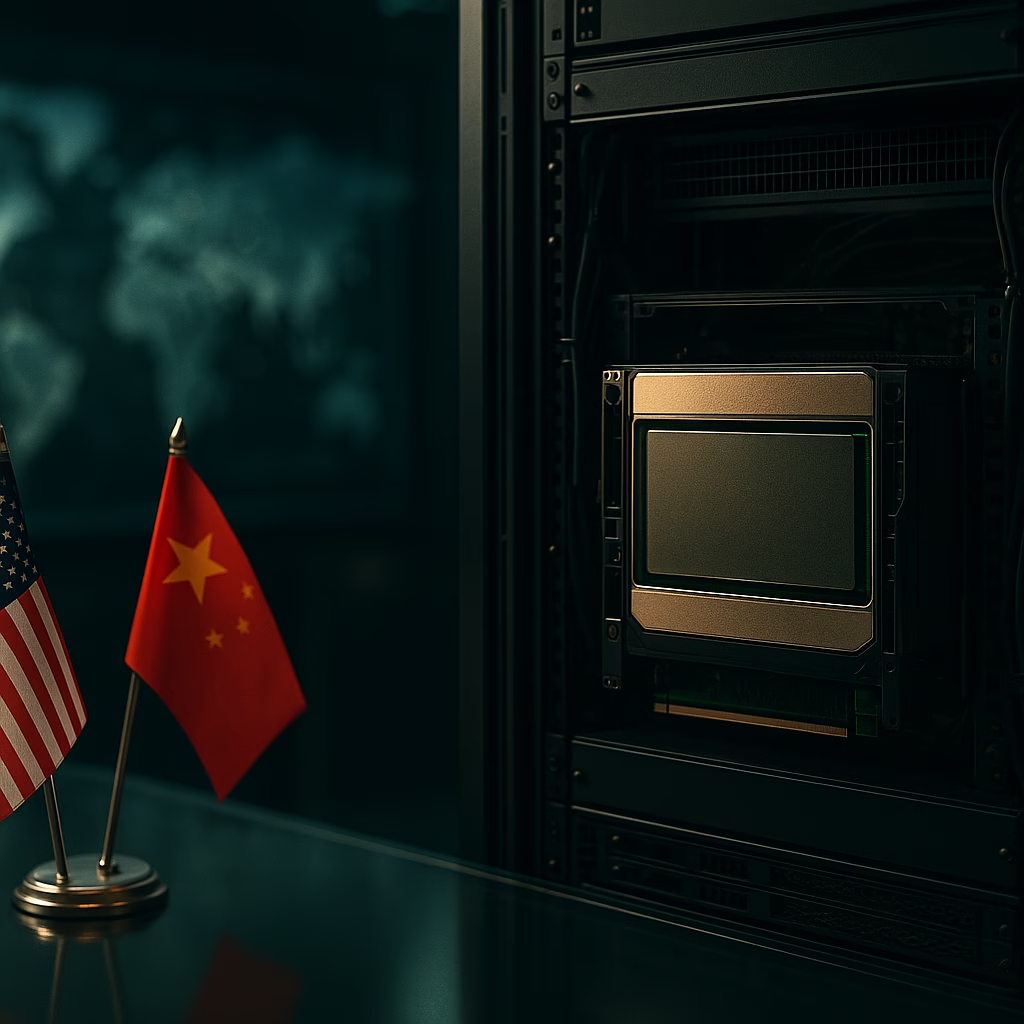
The decision by the United States to allow Nvidia’s H200 artificial intelligence chips to be exported to China marks a significant moment in the ongoing tug-of-war between national security priorities and global technology trade. While Washington has tightened controls on advanced semiconductor exports to China in recent years, this development suggests a more nuanced approach, balancing economic interests, supply chain realities, and geopolitical strategy.
US Export Controls and the Nvidia H200 Exception
Over the past few years, the US government has introduced increasingly strict export restrictions aimed at limiting China’s access to cutting-edge AI and high-performance computing hardware. These measures are designed to slow Beijing’s progress in sensitive areas such as military modernization, surveillance systems, and advanced research.
Within this framework, Nvidia has been a central player. Its GPUs power many of the world’s leading AI models and data centers. Previous US rules forced Nvidia to create “China-compliant” versions of some of its most powerful chips, with reduced performance to ensure they stayed below defined export thresholds.
The H200 chip, an upgrade to Nvidia’s widely used H100, is designed for large-scale AI workloads such as training and deploying generative AI models, recommendation systems, and scientific simulations. By granting export approval for the H200 to China, US regulators have effectively concluded that this specific configuration does not breach the existing security red lines, even while broader concerns about AI capability transfers remain.
Why the H200 Matters for AI and Data Centers
The H200 is part of Nvidia’s high-end data center GPU lineup, which has become the de facto standard for training large AI models. Key characteristics of the chip include:
- High memory bandwidth to handle massive datasets used in AI training.
- Optimized performance for popular AI frameworks and large language models.
- Compatibility with existing Nvidia infrastructure, making it easier for cloud providers and enterprises to scale.
For Chinese cloud companies, research institutions, and large tech platforms, access to Nvidia hardware is critical to staying competitive in the global AI race. Domestic alternatives exist, but many still lag behind in performance, software ecosystem maturity, and developer familiarity.
Balancing Security Risks and Economic Interests
The US government’s evolving policy on semiconductor exports to China reflects a complex balancing act. On one side are national security hawks who argue that any powerful AI hardware shipped to China could indirectly support military or surveillance applications. On the other side are industry stakeholders and economists warning that overly broad restrictions could:
- Hurt US companies’ revenues and reduce funds available for domestic R&D.
- Encourage China to accelerate self-sufficiency in chips and software.
- Disrupt global AI supply chains and cloud infrastructure.
Nvidia is particularly exposed to these dynamics because China has historically been one of its largest markets for data center products. Losing access to that market entirely could impact not only Nvidia’s growth but also the broader US AI ecosystem that relies on continuous reinvestment and innovation.
Implications for China’s AI Ambitions
From China’s perspective, the ability to purchase Nvidia’s H200 chips—even under regulatory scrutiny—is a strategic win. It allows Chinese firms to:
- Deploy and train advanced AI models at global scale.
- Remain competitive in areas such as cloud computing, generative AI, and enterprise AI solutions.
- Buy time while domestic chipmakers work to close the technology gap in GPUs and advanced manufacturing nodes.
However, the approval does not fully remove uncertainty. Export controls can be revised, tightened, or reinterpreted as geopolitical conditions change. Chinese companies may still seek to diversify their supply base and invest more heavily in homegrown chip design and manufacturing to reduce dependence on US technology.
Global AI Competition and Regulatory Uncertainty
The Nvidia H200 export approval highlights a broader trend: AI hardware has become a strategic asset. Governments are no longer treating semiconductors purely as commercial products; they are seen as tools that can shift the balance of power in defense, intelligence, and economic competitiveness.
This environment creates ongoing uncertainty for:
- Cloud providers planning long-term AI infrastructure investments.
- Startups and enterprises depending on predictable access to GPUs.
- Investors trying to understand how policy shifts may affect valuations in the chip and AI sectors.
At the same time, the US decision suggests that a complete technological decoupling is neither imminent nor straightforward. Instead, the likely path is a managed form of interdependence, with carefully calibrated controls on the most sensitive technologies and performance levels.
Conclusion: A Strategic Compromise, Not a Policy Reversal
The US approval of Nvidia’s H200 chip exports to China should be viewed less as a reversal of Washington’s hardening stance on technology transfer and more as a targeted compromise. It underscores how difficult it is to simultaneously safeguard national security, support domestic innovation, and maintain a leading role in global technology markets.
As AI continues to reshape economies and geopolitics, similar decisions will likely recur—each one testing how far governments are willing to go in restricting trade, and how companies like Nvidia adapt their products, strategies, and partnerships to navigate this new era of AI-driven geopolitics.
Reference Sources
Economic Times Telecom – US grants Nvidia H200 chip export to China amid national security concerns
Reuters – US allows Nvidia to export some AI chips to China under new rules
Financial Times – Nvidia navigates US export controls with China-focused AI chips






Leave a Reply