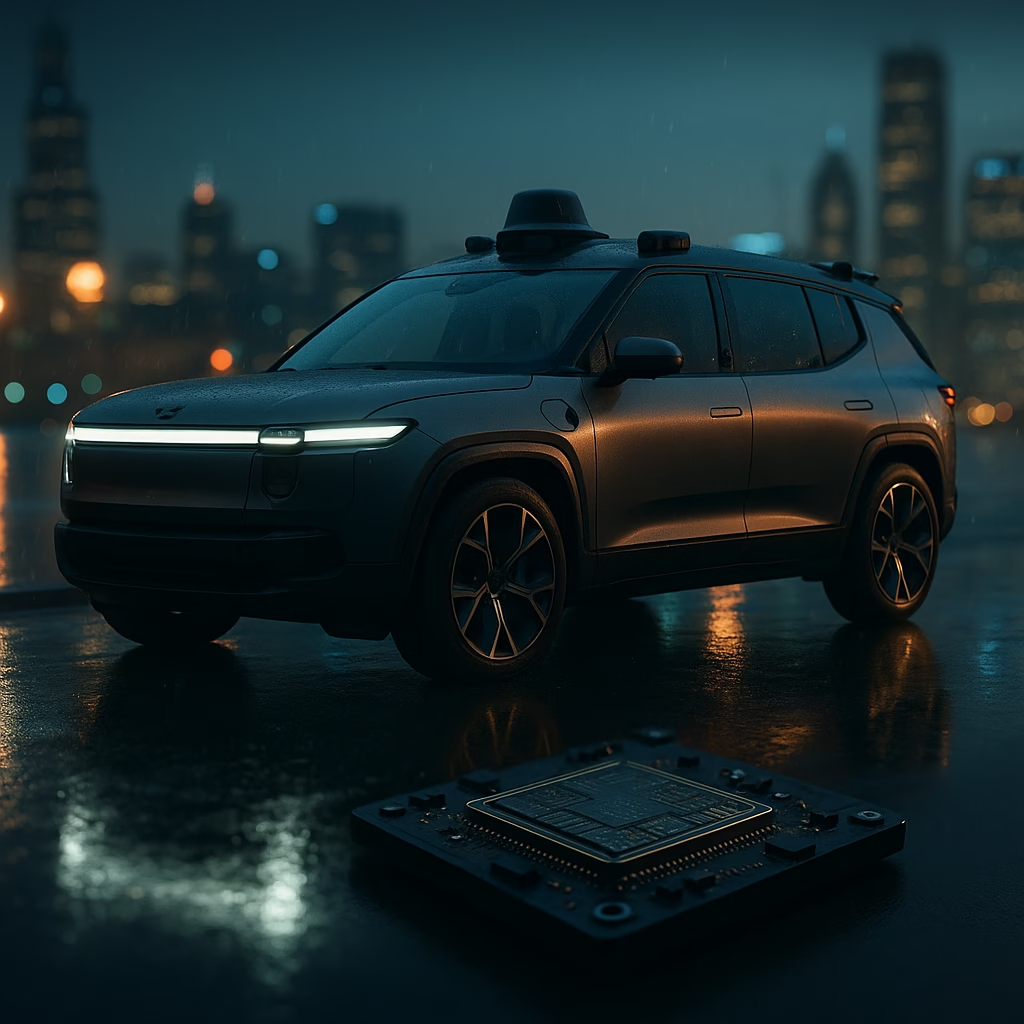
Rivian unveils custom AI chip and ambitious autonomous robotaxi roadmap — what it means for EVs and self-driving cars
Rivian used its latest autonomy and AI-focused event to signal a major strategic shift: the electric vehicle maker is no longer just building adventure trucks and SUVs, it’s building the computing backbone it believes will power the next era of autonomous driving and robotaxis.
At the center of this push is a new, in-house–designed AI chip and a multi-year plan to roll out advanced driver-assistance features, then evolve toward fully autonomous ride-hailing services. The announcement comes as the broader AI market growth accelerates and automakers race to control more of the high-value technology stack inside their vehicles.
Rivian’s custom AI chip: why vertical integration matters
Rivian’s decision to develop its own custom AI processor puts it in a small but growing group of automakers that see proprietary silicon as a competitive advantage. Tesla has long touted its in-house Full Self-Driving (FSD) computer, while other companies rely heavily on chipmakers like Nvidia, Qualcomm, and Intel’s Mobileye for autonomous-driving hardware.
By designing its own chip, Rivian aims to:
- Optimize performance per watt specifically for its vehicles, improving range and efficiency while running increasingly complex AI models.
- Reduce long-term component costs versus buying off-the-shelf hardware, which is crucial in an industry under constant pressure to improve margins.
- Control its software roadmap and avoid being constrained by third-party chip release cycles.
- Differentiate its driving experience from other EVs in a crowded market.
The chip is designed to power Rivian’s next-generation driver-assistance system and future autonomous capabilities by handling real-time processing of data from cameras, radar, and other sensors. As AI models grow in complexity, automakers need more specialized computing to keep latency low and safety high.
From driver assistance to robotaxis: Rivian’s autonomy roadmap
Rivian’s event laid out a phased roadmap that starts with improved ADAS (advanced driver-assistance systems) and extends toward Level 4 autonomy, where a vehicle can operate without human intervention in defined conditions.
Near term, Rivian is focused on enhancing features such as:
- Highway driving assistance with lane-centering and adaptive cruise control.
- Automated lane changes and more natural vehicle behavior in traffic.
- Improved automated parking and low-speed maneuvering.
Over time, the company plans to leverage the same hardware foundation for more advanced capabilities with an eye toward autonomous ride-hailing. That could eventually position Rivian as a player in the emerging robotaxi space, alongside companies like Waymo, Cruise, and Tesla’s planned robotaxi network.
However, Rivian is clear that full autonomy depends not just on technology but on regulatory frameworks, safety validation, and real-world data. The roadmap is ambitious but will be executed in stages, with continuous software updates and feature rollouts.
Why now? AI, EV demand, and the broader economic outlook
Rivian’s timing reflects several converging forces in the global economy and tech sector:
- AI market growth: The rapid expansion of generative AI and edge computing has put a spotlight on specialized chips and on-device intelligence. Automakers see an opportunity to capture more value by owning critical AI components.
- EV competition: As more electric vehicles hit the market, differentiating on range and price alone is harder. Features like autonomous driving, connected services, and software-defined upgrades are becoming central to long-term growth stories.
- Macroeconomic uncertainty: With investors closely watching inflation trends, interest rates, and the broader economic outlook, high-growth companies are under pressure to show credible paths to profitability and recurring revenue. A scalable autonomy platform could support subscription-based features and fleet services.
Rivian’s push into in-house AI hardware and autonomy is therefore not just a tech decision—it’s a strategic response to shifting market conditions and investor expectations.
Competitive landscape: Rivian vs. Tesla, legacy automakers, and tech players
Rivian’s move will inevitably draw comparisons to Tesla, which has long emphasized vertical integration and proprietary FSD hardware and software. Tesla’s early lead in deploying large fleets with advanced driver-assistance has given it a significant data advantage.
At the same time, legacy automakers and tech companies are investing heavily in similar areas:
- GM and Cruise are pursuing a robotaxi-first strategy, with dedicated autonomous vehicles for urban ride-hailing.
- Waymo, backed by Alphabet, continues to expand its driverless services in select cities.
- Mercedes-Benz, BMW, and others are partnering with chipmakers and software firms to offer Level 2+ and Level 3 systems, especially in Europe and parts of the U.S.
Rivian’s differentiation lies in its brand positioning—adventure-focused EVs and commercial vans—and its decision to blend consumer vehicles, commercial fleets, and future robotaxi ambitions on a single technology platform. If successful, this could allow the company to share development costs across multiple business lines.
Risks, challenges, and what investors will watch
Despite the excitement around in-house AI chips and autonomy, the path ahead is complex and capital intensive. Key challenges include:
- Execution risk: Building competitive silicon, safety-critical software, and scalable manufacturing is difficult, especially for a relatively young automaker.
- Regulatory and safety hurdles: High-profile robotaxi incidents have drawn scrutiny from regulators, making approvals slower and more cautious.
- Cost discipline: In an environment shaped by uncertain demand, shifting economic outlook, and pressure on EV pricing, Rivian must balance innovation with careful cash management.
Investors and industry analysts will be watching for concrete milestones: hardware integration into new vehicle platforms, real-world performance of the upgraded driver-assistance system, partnerships around mapping and data, and any pilots that move the company closer to commercial robotaxi services.
What this means for the future of Rivian and autonomous EVs
Rivian’s AI chip and autonomy roadmap underscore a bigger industry shift: the car is becoming a software-defined, AI-powered device on wheels. For Rivian, owning the key components of that stack—from EV platforms to custom silicon—could unlock new revenue streams and a stronger competitive position, if it can execute.
For consumers, the near-term impact will show up as more capable and refined driver-assistance features in future Rivian models. Over the longer term, the same technology could underpin autonomous ride-hailing services, new mobility business models, and deeper integration with smart cities and connected infrastructure.
As global automakers adapt to evolving AI market growth, shifting inflation trends, and a volatile economic outlook, strategies like Rivian’s—doubling down on AI, autonomy, and vertical integration—are likely to define which companies lead the next decade of transportation.






Leave a Reply