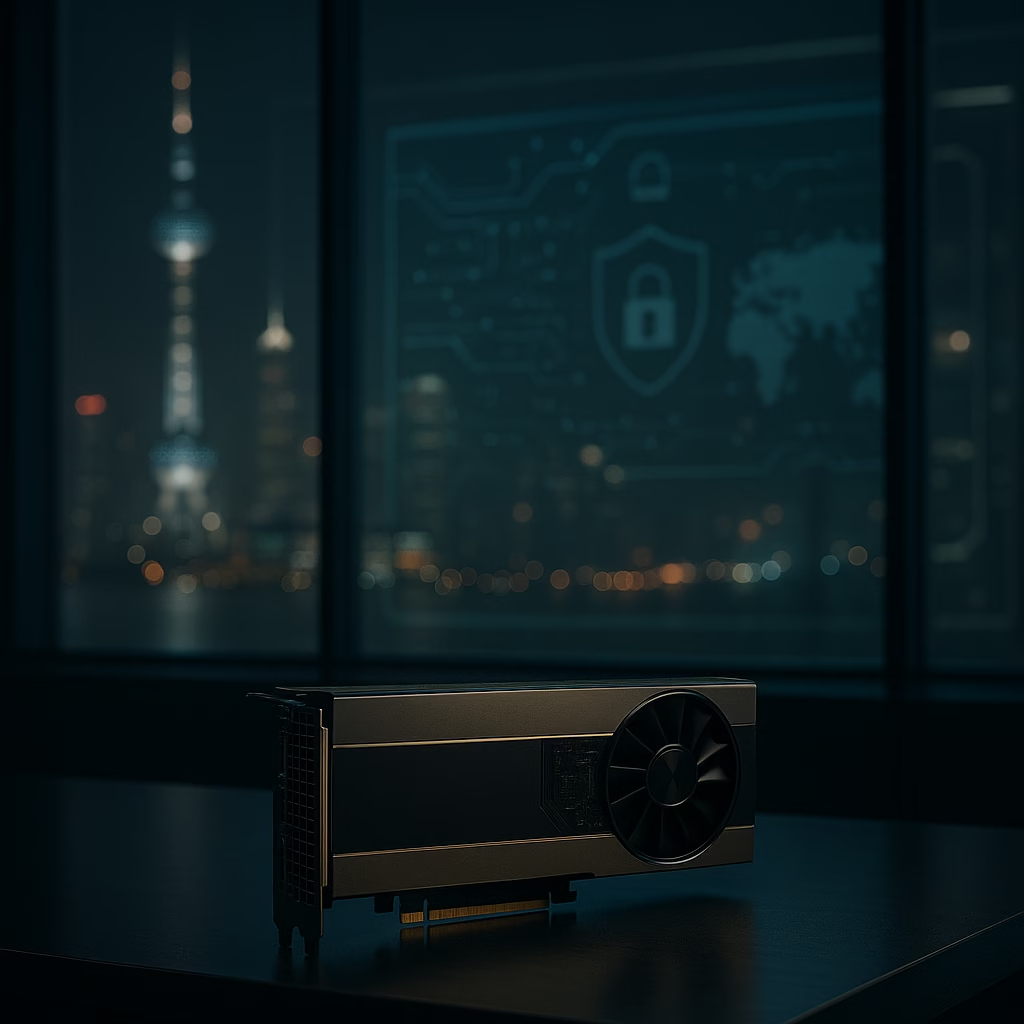
China weighs Nvidia H200 access amid AI ambitions and security
China’s regulators are facing a complex strategic question: whether to allow access to Nvidia’s powerful new H200 artificial intelligence (AI) chip, a decision that will shape the country’s technological trajectory, industrial policy, and approach to national security in the coming years.
At the heart of the debate is a familiar tension in Beijing’s policymaking: how to balance short-term gains from foreign cutting-edge technology with the long-term goal of self-reliance in critical sectors. The decision on the H200 is emerging as a test case for how China will navigate US export controls, global supply-chain pressure, and its own ambitions to lead in AI.
Why Nvidia’s H200 matters for China’s AI ecosystem
Nvidia’s H200 is an advanced data-center GPU designed for large-scale AI training and inference. It follows the company’s high-end AI chips such as the A100 and H100, which have already become the backbone of generative AI development worldwide.
For Chinese tech giants and AI startups, access to the H200 would provide:
- Higher performance for training large language models (LLMs) and other foundation models.
- Improved energy efficiency, lowering the cost of operating massive data centers.
- Compatibility with existing Nvidia software ecosystems, such as CUDA and specialized AI frameworks that many Chinese firms already rely on.
In a global AI race where model size, training speed, and deployment scalability are critical competitive factors, the H200 could significantly bolster China’s major cloud and internet platforms. However, this technological advantage comes at a time when Washington is tightening export restrictions on high-end chips destined for China, precisely because of their strategic relevance.
US export controls and Beijing’s strategic dilemma
The H200 decision sits within a broader geopolitical and regulatory environment. The United States has introduced multiple rounds of export controls on advanced semiconductors and AI chips, aiming to limit China’s access to hardware that could be used for military, surveillance, or advanced computing applications.
These controls have forced Nvidia to design “China-specific” versions of some of its products with reduced performance, in an attempt to comply with US regulations while still serving a large and lucrative market. Whether the H200 – or a modified variant – can legally be sold to China depends on how US rules interpret its computing power, interconnect speed, and potential military applications.
For Chinese regulators and policymakers, this creates a multi-layered dilemma:
- Short-term competitiveness vs. long-term independence: Allowing Nvidia’s latest chips could accelerate domestic AI innovation, but deepen reliance on a foreign vendor vulnerable to political pressure.
- Security concerns: Advanced foreign hardware may raise questions about supply continuity, potential vulnerabilities, or over-dependence in critical sectors such as defense, telecoms, and finance.
- Industrial policy alignment: China’s long-running “dual circulation” and “self-reliance in science and technology” strategies emphasize building local champions in semiconductors and AI infrastructure.
Domestic chip ambitions: opportunity and constraint
China has poured substantial resources into its domestic semiconductor ecosystem, from chip design houses and foundries to AI accelerator startups. Companies such as Huawei’s HiSilicon and various homegrown AI chipmakers are working on GPUs, AI accelerators, and custom processors intended to reduce dependence on US technology.
Yet, despite rapid progress, domestic options often still lag Nvidia’s top-tier products in terms of:
- Raw compute performance for training state-of-the-art models.
- Software ecosystem maturity, including developer tools, libraries, and optimization frameworks.
- Scalability and interoperability with existing global AI infrastructure.
This performance gap complicates regulatory decisions. Restricting or discouraging Nvidia’s H200 might accelerate adoption of domestic chips by necessity, but it could also slow the overall pace of Chinese AI innovation at a time when global rivals are moving quickly.
Regulatory calculus: weighing national security and market needs
Any decision regarding the H200 will likely involve multiple agencies and policy priorities. While specific internal deliberations are not public, several broad considerations are visible from China’s past regulatory patterns in tech and data:
- National security and data governance: China has tightened rules around critical information infrastructure and cross-border data flows, signaling a preference for secure, controllable technology stacks in sensitive sectors.
- Industrial upgrading: Authorities want to ensure that foreign technology imports do not permanently crowd out domestic innovation, particularly in strategic industries like chips and AI.
- Economic growth and employment: AI is seen as a key driver of productivity and new business models. Restricting access to cutting-edge hardware could impact competitiveness of cloud providers, internet platforms, and AI service companies.
Regulators may therefore seek a middle path: allowing some level of access to Nvidia’s hardware, but steering critical projects, especially in government-linked or defense-related domains, toward domestic chips where possible. They could also impose conditions that encourage technology transfer, joint ventures, or localized R&D, consistent with broader industrial policy goals.
Implications for the global AI and chip landscape
The outcome of China’s stance on the H200 will resonate beyond its borders:
- For Nvidia, China remains one of the world’s largest markets for AI data-center chips. Any significant restriction or disruption could reshape its revenue profile and product strategy.
- For global AI competition, China’s access to high-end GPUs will influence how quickly its companies can develop frontier models and compete with US and European leaders.
- For supply chains, further fragmentation between US-aligned and China-centric ecosystems could accelerate the emergence of parallel hardware and software stacks in AI.
At the same time, China’s push for domestic alternatives may eventually create new global competitors to Nvidia and other US chipmakers, especially if local products become price-competitive and technically mature.
Conclusion: a pivotal decision in China’s AI trajectory
China’s deliberations over access to Nvidia’s H200 chip are about far more than a single product. They encapsulate the country’s broader struggle to reconcile immediate technological needs with long-term strategic autonomy in a world of intensifying tech rivalry.
Allowing broad use of the H200 would give Chinese AI developers a powerful tool to accelerate innovation in the near term. Yet it also risks reinforcing dependence on a supply line heavily influenced by US policy. Conversely, a tougher stance that limits or redirects demand toward domestic chips could strengthen China’s semiconductor ecosystem over time, but at the cost of slower AI progress in the short run.
How Beijing balances these trade-offs will help define the contours of the global AI landscape, influencing not only China’s own development path but also how technology, security, and economic power intersect in the coming decade.
Reference Sources
MLex – China to weigh AI gains with self-reliance, security in Nvidia H200 access decision
Reuters – Nvidia designs new chips for China to comply with US export rules
Financial Times – US curbs on AI chips to China hit Nvidia and rivals






Leave a Reply