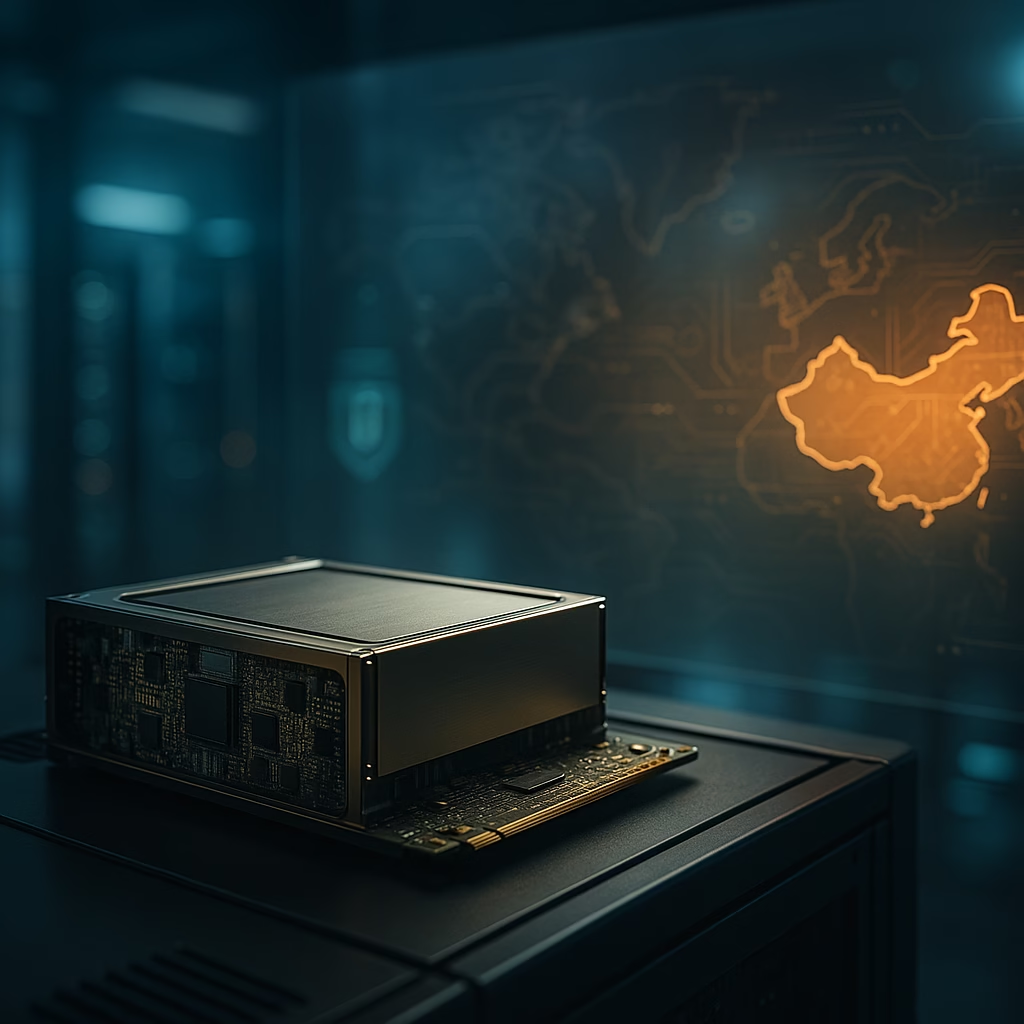
China’s debate over access to Nvidia’s advanced H200 artificial intelligence chips is emerging as a critical test of how the country balances technological ambition, national security, and industrial self-reliance. As US export controls tighten around cutting-edge semiconductors, Beijing faces a strategic choice: accept limited access to downgraded US chips to accelerate AI development in the short term, or double down on domestic alternatives and long-term resilience, even if it slows progress.
Why Nvidia’s H200 Matters So Much
Nvidia’s H200 chip is designed to power large-scale AI workloads, from training massive language models to handling high-intensity data center operations. It is a successor to the widely used H100 and offers:
- Higher memory bandwidth for faster data movement during AI training and inference.
- Improved performance per watt, critical for hyperscale cloud and AI data centers.
- Better support for large models, including generative AI systems, recommendation engines, and advanced analytics.
For Chinese tech giants and research institutes, chips like the H200 are central to maintaining competitiveness in the global AI race. However, Washington’s export control regime now targets precisely these high-performance processors, seeing them as dual-use technologies with significant military applications.
US Export Controls and China’s Strategic Dilemma
Recent US measures have restricted Nvidia from selling its most powerful AI chips, such as the A100 and H100, to Chinese customers. In response, Nvidia began designing “China-specific” versions with reduced performance to stay within regulatory thresholds. The H200 has now become part of this evolving policy landscape.
From Beijing’s perspective, this creates a complex trade-off:
- Short-term AI gains: Even a downgraded H200 could significantly boost China’s AI capabilities, supporting cloud providers, large internet platforms, and research institutions.
- Long-term technological sovereignty: Heavy reliance on foreign chips leaves China exposed to sudden policy shifts, supply disruptions, and strategic vulnerability.
- Security and control concerns: There are ongoing debates over whether dependence on US-origin hardware could pose risks in sensitive sectors like defense, critical infrastructure, and government IT systems.
Beijing’s Dual Goals: AI Leadership and Self-Reliance
China has made AI leadership and semiconductor independence central pillars of its industrial strategy. Policy frameworks such as “Made in China 2025” and subsequent five-year plans emphasize:
- Developing a fully localized semiconductor ecosystem, from design to fabrication to packaging.
- Reducing reliance on foreign technology in strategic industries, including AI, 5G, and cloud computing.
- Supporting domestic champions through subsidies, procurement preferences, and research funding.
Access to Nvidia’s H200 could accelerate AI deployment across finance, e-commerce, smart manufacturing, and autonomous driving. Yet each incremental dependency on US hardware runs counter to Beijing’s long-stated goal of “indigenous innovation” and greater control over core technologies.
Domestic Chipmakers Under Pressure
The debate over the H200 also has implications for China’s own chip companies, including GPU and AI accelerator designers. If US-origin chips remain available—even in constrained form—Chinese customers may prefer them for their reliability, mature software stack, and ecosystem support.
On the other hand, tighter restrictions can act as a forcing mechanism, pushing cloud providers, internet firms, and AI startups to adopt domestic solutions. This dynamic has already begun to play out:
- Chinese GPU makers are racing to close the performance gap with Nvidia, especially for training large models.
- Local cloud platforms are building software frameworks and toolchains optimized for homegrown chips.
- Government procurement increasingly favors domestic hardware for sensitive or strategic applications.
Whether China allows broad or limited access to the H200 will send a strong signal to the domestic industry about how aggressively it must move toward self-reliance.
Security, Compliance, and the Regulatory Lens
Chinese regulators are expected to examine Nvidia’s H200 through multiple lenses:
- National security: Authorities will assess whether deploying US-origin AI chips in key sectors could expose China to data, cyber, or supply-chain risks.
- Industrial policy alignment: Any decision must be consistent with long-term strategic goals to build a robust, independent semiconductor base.
- Geopolitical signaling: How China responds to US export control pressure will be closely watched by global markets and foreign technology suppliers.
In practice, this could result in a nuanced outcome: selective use of Nvidia chips in commercial or low-risk environments, while critical infrastructure and defense-related systems increasingly prioritize domestic hardware.
Global AI Competition and the Cost of Fragmentation
The Nvidia H200 debate is part of a broader technological decoupling between the US and China. Semiconductor supply chains that once spanned continents are being reconfigured along geopolitical lines. This fragmentation carries several global consequences:
- Higher costs and duplication of R&D as countries build parallel ecosystems.
- Slower diffusion of cutting-edge AI tools across borders.
- Increased uncertainty for multinational companies operating in both US and Chinese markets.
For global AI development, restricted access to leading-edge chips in a major market like China can influence where talent, capital, and research clusters form—and how quickly AI capabilities advance worldwide.
Outlook: A Careful Balancing Act
China’s decision on Nvidia’s H200 access will likely reflect a pragmatic balance rather than an absolute yes-or-no stance. Authorities must weigh:
- The immediate need to keep Chinese AI companies competitive.
- The strategic imperative to avoid long-term dependence on US technology.
- The security risks of embedding foreign chips in sensitive systems.
What emerges may be a two-track approach: tactical use of available foreign chips to sustain growth today, coupled with aggressive investment in domestic alternatives for tomorrow. Whatever the final contours, the H200 case underscores that AI hardware is no longer just a commercial product—it is a lever of economic power and national security, and decisions about its access will shape the trajectory of China’s AI ecosystem for years to come.
Reference Sources
China to weigh AI gains with self-reliance, security in Nvidia H200 access decision – MLex
Nvidia designs new China-focused AI chip to comply with US export rules – Reuters
US curbs on AI chips to China hit Nvidia and global tech supply chains – Financial Times






Leave a Reply