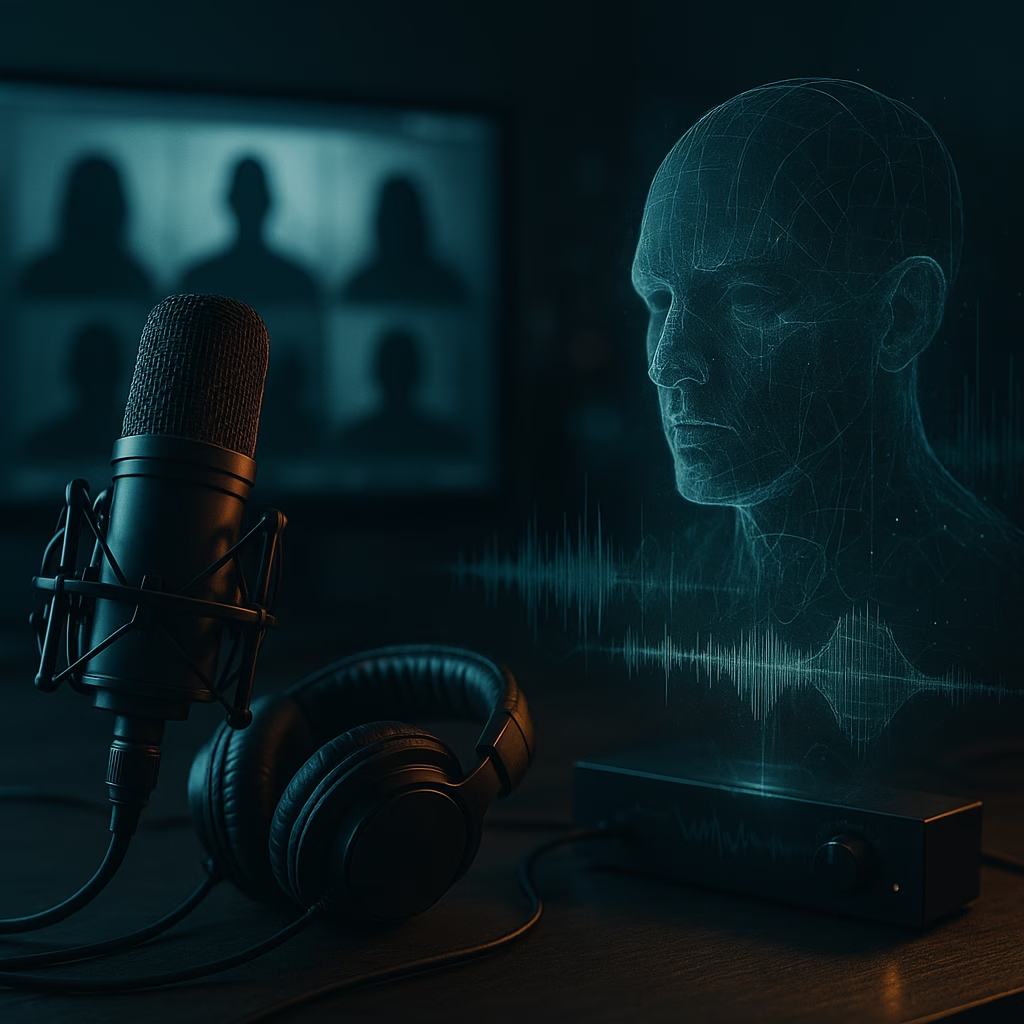
Artificial intelligence has supercharged the way extremist groups create and spread propaganda, and one of the most alarming developments is the rapid rise of AI voice cloning. With cheap, accessible tools, far-right networks and Islamist extremists are now able to fabricate convincing audio that sounds like trusted leaders, celebrities, or ordinary citizens — all at industrial scale.
AI voice cloning turbocharges extremist propaganda and recruitment online
A new frontier in digital extremism
Voice cloning was once a niche, technically demanding process. Today, it is as simple as uploading a short voice sample to an online platform and letting powerful generative AI models do the rest. The Guardian’s reporting highlights how extremists have begun to exploit this shift, using cloned voices to:
- Recreate the voices of historical figures, including Nazi leaders, to deliver tailored propaganda.
- Mimic the speech of Islamic State supporters to produce new “sermons” and recruitment pitches.
- Record “personalized” audio messages targeting individuals and communities in multiple languages.
These technologies are being folded into existing propaganda ecosystems, from encrypted messaging apps to fringe social platforms. Instead of relying only on text posts, grainy videos, or repurposed speeches, extremists can now publish seemingly fresh, authentic-sounding content at scale, while staying physically anonymous.
From deepfakes to deep-voices: why audio is so persuasive
Much attention has focused on deepfake video, but audio carries a different kind of psychological power. People tend to trust what they hear from a familiar or authoritative-sounding voice, especially when it is framed as a leaked recording, a private message, or a “banned” speech. AI voice clones exploit that trust.
According to researchers cited in the article, extremists are using cloned voices to:
- Repackage old ideological texts in modern, conversational language.
- Produce “Q&A” style audio that answers common doubts of potential recruits.
- Simulate charismatic leaders delivering new messages long after they are dead, jailed, or in hiding.
Unlike traditional audio editing, AI-generated speech can be endlessly customized: scripts can be adjusted for different age groups, subcultures, or regions, and then rendered in the same recognizable voice. This makes voice cloning a powerful micro-targeting tool inside extremist networks.
Low cost, high impact: why extremists are adopting AI so quickly
The article underscores a crucial point: extremists are early adopters when technology lowers the cost of propaganda. Just as they previously leveraged social media, encrypted messaging, and anonymous forums, they now see an opportunity in generative AI.
Key factors driving adoption include:
- Minimal technical skills required: Many voice-cloning tools are web-based with simple interfaces.
- Little to no financial barrier: Free or low-cost platforms allow experimentation without major funding.
- Global reach: AI voices can be generated in multiple languages and accents, aligning with broader concerns about AI market growth and the rapid diffusion of such tools worldwide.
- Anonymity and deniability: Extremists can produce audio without revealing their real voices, complicating law-enforcement efforts.
In a broader technological and economic outlook, these tools are emerging at the same time as governments, regulators, and tech companies are already struggling to keep up with misinformation, election interference, and online harassment. Voice cloning adds yet another layer of complexity.
Risks beyond propaganda: fraud, disinformation, and trust collapse
While The Guardian’s piece focuses on extremist propaganda, the same underlying technology is being used in scams and political disinformation. Familiar concerns about inflation trends or economic outlook can be weaponized by fake audio purporting to come from officials, business leaders, or trusted commentators.
In the extremist context, this can manifest as:
- Fake “leaked” recordings of politicians or community leaders insulting particular groups, stoking anger and division.
- Audio purporting to show secret negotiations, ceasefires, or betrayals, undermining trust in institutions.
- Fraudulent fundraising messages that sound like known militant leaders, redirecting money to new cells or copycat groups.
The cumulative effect is a potential erosion of confidence in any digital recording. When anyone’s voice can be convincingly forged, citizens may begin to doubt even genuine evidence of wrongdoing — a dynamic that benefits extremists who thrive in environments of confusion and distrust.
Platform responsibility and regulatory gaps
The Guardian article points to a growing tension: technology companies are racing to roll out ever more sophisticated generative AI tools, while safeguards remain partial and inconsistent. Some platforms have introduced:
- Policies banning explicit extremist content and praise of terrorist organizations.
- Watermarking or detection systems aimed at identifying AI-generated audio.
- Human and automated moderation teams tasked with reviewing flagged material.
However, enforcement is uneven, and extremists are adept at circumventing filters through coded language, private channels, and constant re-uploads. Meanwhile, smaller AI providers often lack robust moderation capacity, creating a patchwork of risk across the broader digital ecosystem.
On the policy side, governments are beginning to discuss AI regulation in the context of national security, misinformation, and online harms. Yet rules are still emerging, and many legal frameworks were designed long before generative AI and voice cloning were technically feasible.
What can be done now?
The article implies that no single actor can solve this problem; instead, it requires coordinated action across sectors. Steps that experts and advocates argue are necessary include:
- Stronger transparency from AI firms about how voice models are trained, what guardrails exist, and how extremist abuses are handled.
- Investment in detection tools that can flag AI-generated or manipulated audio, especially for use by journalists, civil society, and election authorities.
- Clearer laws and standards around the use of voice cloning, particularly in contexts linked to terrorism, hate speech, or incitement to violence.
- Digital literacy campaigns that help the public understand how easily audio can be faked, encouraging healthy skepticism without tipping into total cynicism.
Ultimately, the rise of AI voice cloning in extremist propaganda is part of a broader pattern: powerful technologies are being integrated into existing ideological and violent movements faster than institutions can adapt. As the global conversation on AI safety, security, and regulation accelerates, the misuse of cloned voices by Nazis, Islamic State supporters, and other extremist networks will remain a critical test of whether societies can harness innovation without letting it deepen division and harm.
Reference Sources
The Guardian – AI voice cloning turbocharges Nazis and Islamic State propaganda






Leave a Reply