
Securing the “AI Factory” Era: Why Fortinet and NVIDIA Are Pairing Up
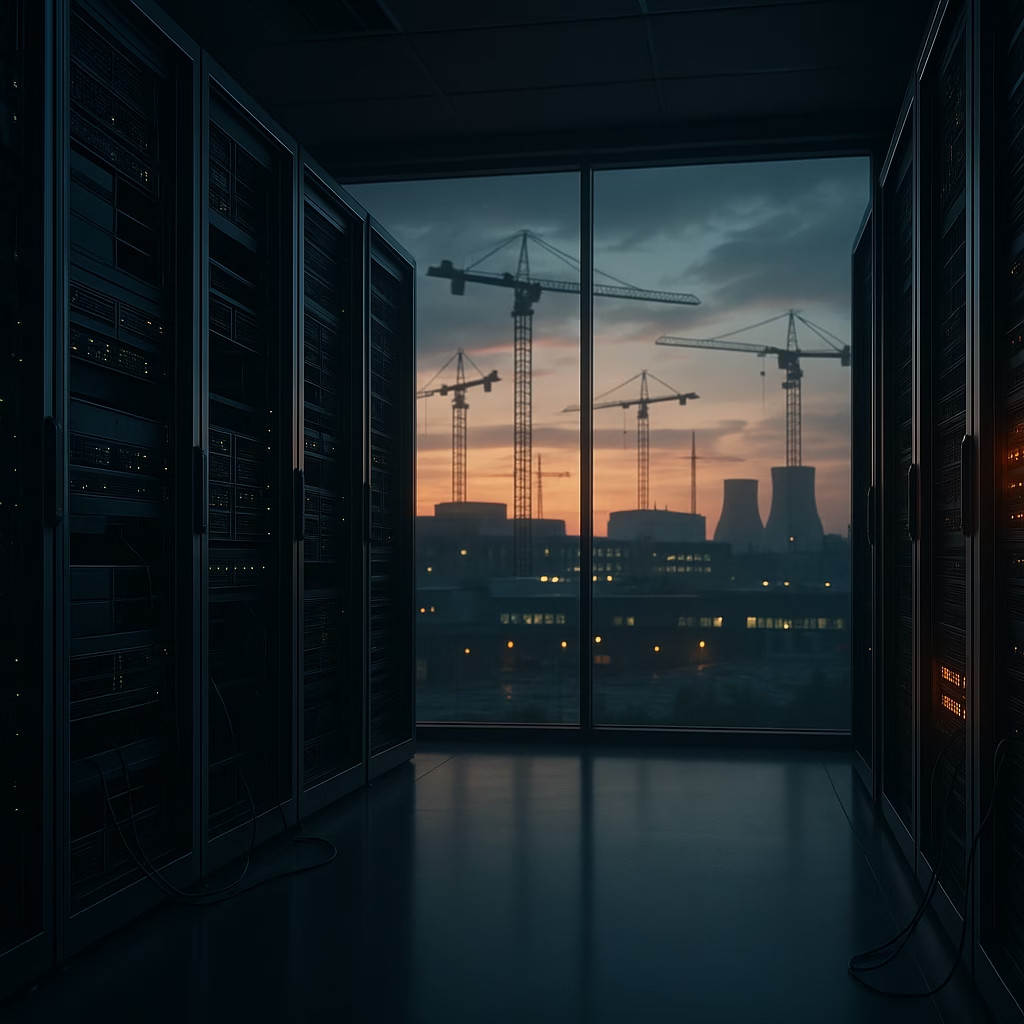
As enterprises pour capital into AI infrastructure—especially GPU-dense clusters used for training, inference, and data pipelines—security teams are facing a familiar problem in a new form: how to protect high-throughput, east-west traffic inside modern data centers without slowing down the very workloads executives are betting on. In response to this shift, Fortinet has integrated FortiGate VM with NVIDIA BlueField-3, aiming to deliver stronger, faster security controls for what the industry increasingly calls the “AI factory”—the compute, networking, and storage stack that turns data into AI outcomes.
This announcement reflects a broader market reality: AI is driving a new infrastructure refresh cycle, and security is being forced to evolve from perimeter-centric controls to distributed, performance-aware protections that can be applied close to workloads.
What FortiGate VM + NVIDIA BlueField-3 Integration Means
FortiGate VM is Fortinet’s virtual next-generation firewall (NGFW), designed to run in virtualized and cloud environments. NVIDIA BlueField-3 is a data processing unit (DPU) built to offload networking, storage, and security tasks from the CPU. By integrating FortiGate VM with BlueField-3, the goal is to accelerate security processing while preserving CPU cycles for AI applications.
In practical terms, this pairing targets a common bottleneck in modern environments: as traffic volumes rise (especially within GPU clusters), security inspection can become a performance tax. Offloading select functions to a DPU helps reduce that tax, aligning with the trend toward hardware-assisted security in high-performance data centers.
Why AI Workloads Raise the Security Stakes
AI systems are not just “another application.” They are built on massive datasets, expensive compute, and complex supply chains of software components. That combination creates a high-value target for attackers. Beyond traditional threats, AI environments introduce risks such as:
- Lateral movement inside the data center, where attackers pivot between nodes and services.
- Data exfiltration of proprietary training data, prompts, or model artifacts.
- Service disruption that can idle costly GPU resources and impact time-to-market.
- Misconfiguration exposure across fast-changing clusters, containers, and orchestrators.
Because AI pipelines often depend on rapid scaling and frequent iteration, organizations need security that can keep pace—without turning into an operational bottleneck.
Performance and Zero-Trust Trends Converge in the Data Center
Two major industry trends are colliding in AI infrastructure:
- Zero Trust segmentation: limiting communication paths so workloads only talk to what they must.
- Acceleration and offload: using specialized hardware to maintain throughput while applying deep inspection.
From an economic perspective, this makes sense. GPU clusters are expensive to build and run, and idle or underutilized accelerators can quickly inflate costs. As a result, there is growing pressure to adopt security designs that protect without throttling the environment. DPUs like BlueField-3 have emerged as a way to enforce policy closer to the workload while keeping CPU resources available for AI tasks.
Where This Integration Fits in Real Deployments
Enterprises building AI-capable data centers often operate hybrid environments—part on-premises, part colocation, part public cloud. Virtual firewalls like FortiGate VM are attractive because they can align with virtualization and cloud-native patterns. With DPU acceleration, organizations can pursue:
- High-throughput segmentation between AI tenants, projects, or business units.
- Consistent policy enforcement across virtualized and container-heavy environments.
- Reduced CPU overhead for security processing, preserving compute for training and inference.
- Scalable inspection as east-west traffic grows inside GPU and storage fabrics.
While every architecture differs, the direction is clear: AI-era data centers increasingly treat security as a built-in platform capability rather than a bolt-on appliance.
What to Watch Next
This integration also signals where enterprise security is heading more broadly. As infrastructure becomes more specialized—GPUs for compute, SmartNICs/DPUs for data movement—security controls are likely to become more embedded and performance-tuned. For security teams, that means rethinking capacity planning, selecting platforms that support automation, and ensuring visibility keeps up with distributed enforcement points.
Conclusion: Security That Matches AI’s Speed
Fortinet’s integration of FortiGate VM with NVIDIA BlueField-3 is best understood as a response to AI’s defining operational challenge: scale and speed. The “AI factory” model demands high-throughput networking and nonstop iteration, and security must deliver strong controls without undermining performance. Hardware-accelerated approaches—paired with virtualized, policy-driven security—are becoming a practical path for organizations that want to protect valuable models and data while keeping GPU investments productive.
Reference Sources
NVIDIA – Data Processing Units (BlueField DPU) overview
Fortinet – FortiGate Virtual Appliance (FortiGate VM) product page





Leave a Reply