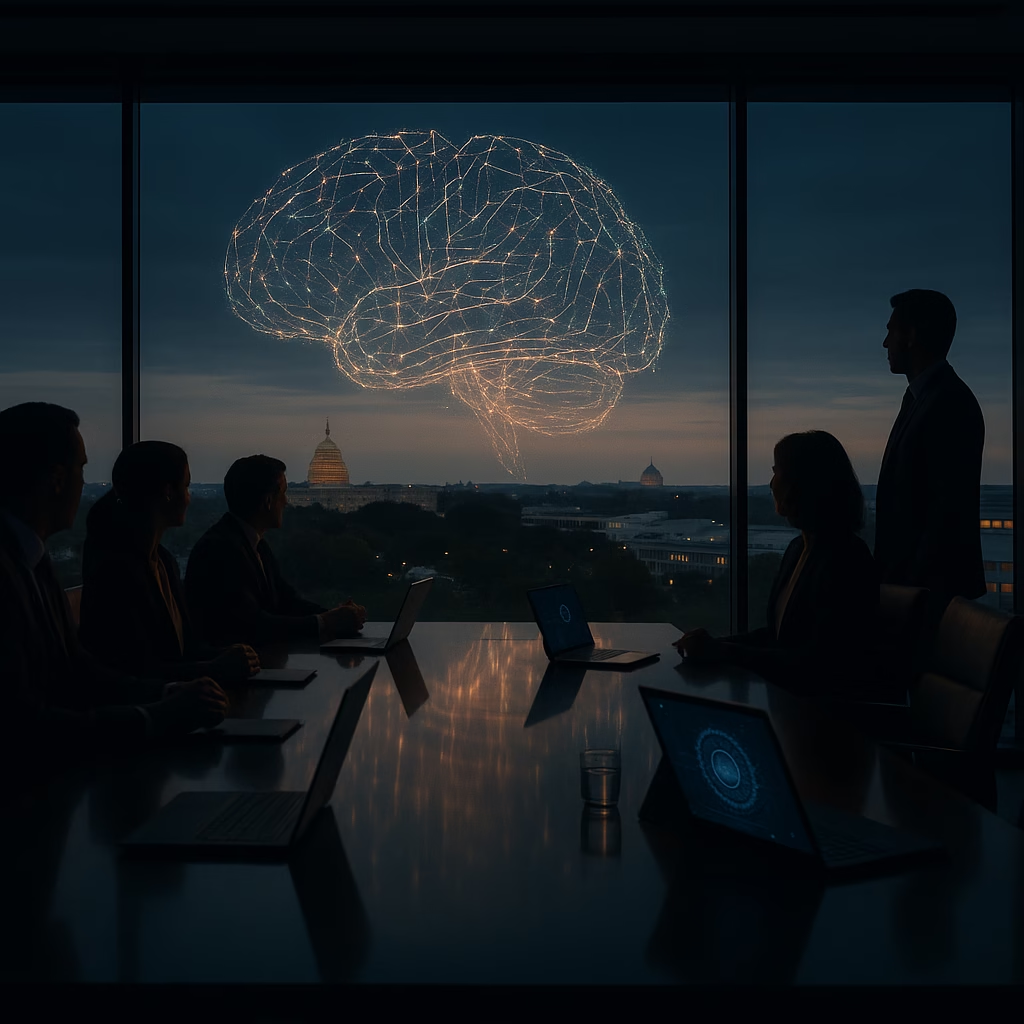
Big Tech companies are entering a period of intense uncertainty as Donald Trump prepares to install a new AI czar, a move that could rapidly reorder how artificial intelligence is regulated, funded, and deployed across the U.S. economy. The incoming administration’s signals on AI policy — skeptical of current rules, wary of “woke tech,” and focused on national security and economic competition — have already begun to unsettle Silicon Valley, Wall Street, and policymakers in Washington.
Big Tech braces for Trump AI czar shift in power
Under President Biden, the White House framed AI primarily through the lens of risk management: guardrails for powerful models, voluntary safety commitments, and executive orders that nudged agencies to monitor AI’s impact on jobs, civil rights, and national security. That approach aligned closely with many large technology firms that have invested heavily in trust-and-safety teams, responsible AI research, and global standards.
The Trump team is signaling a very different philosophy. Rather than leading with caution, the next administration appears poised to emphasize rapid deployment, deregulation, and geopolitical competition — particularly against China — as it chooses a central figure to coordinate AI policy across government. For Big Tech, that shift could either unlock new opportunities or blow up carefully negotiated rules they have spent years shaping.
A new power center for AI policy
The idea of an “AI czar” reflects how central artificial intelligence has become to the economic outlook of the U.S. and its strategic posture. The role is expected to act as a hub between the White House, federal agencies, the national security apparatus, and private industry. That means whoever gets the job will wield significant influence over:
- How strictly AI safety and security standards are enforced
- What kinds of AI models face export controls or national security limits
- Which sectors receive federal AI funding and research support
- How the U.S. positions itself in global negotiations on AI governance
For the largest platforms and AI labs, this is not just another Washington appointment; it is a potential shift in the center of gravity for tech policy, with direct implications for product roadmaps, capital investment, and global expansion strategies.
Silicon Valley’s uneasy recalibration
Major tech firms have grown accustomed to navigating a Democratic-led policy environment that, while often critical, has embraced a relatively predictable regulatory playbook. Executive orders, guidance on AI safety, and interagency processes created a framework that companies could plan around, even if they disagreed with some of the details.
The prospect of a Trump-appointed AI czar introduces a different kind of uncertainty. Industry insiders are weighing several scenarios:
- Deregulation and speed: A more permissive approach could ease compliance burdens and accelerate AI deployment in areas like health care, finance, and defense — potentially boosting AI market growth and productivity.
- Political pressure on content and moderation: Tech leaders worry that AI policy could be used as leverage in ongoing battles over content moderation, algorithms, and perceived political bias on major platforms.
- Fragmented regulatory strategy: If the AI czar clashes with independent agencies or career officials, companies may face a patchwork of shifting guidance rather than a stable national strategy.
Executives are already adjusting their Washington strategies: reinforcing lobbying teams, revisiting public messaging, and preparing to highlight AI’s role in economic growth, jobs, and U.S. competitiveness to an administration that prioritizes visible wins on the economy and national security.
National security, China, and the AI race
One area where Trump’s AI czar is likely to lean in aggressively is the U.S.–China technology rivalry. AI is now at the core of debates over export controls, advanced chips, and cloud infrastructure. Under Biden, the U.S. moved to restrict China’s access to high-end semiconductors and tools, citing military and surveillance risks.
A Trump-aligned AI czar could double down on that strategy, pressing for:
- Tighter export rules on AI chips and advanced models
- Expanded scrutiny of foreign investment in U.S. AI startups
- Greater integration of private AI firms into defense and intelligence projects
For Big Tech, this raises both opportunity and risk. Defense and national security contracts could expand, but companies with global footprints must navigate a more volatile environment for cross-border data flows, cloud services, and AI research collaboration.
Regulatory reset or regulatory vacuum?
The Biden administration’s AI framework — including its executive order and agency guidance — may not be fully dismantled, but Trump’s AI czar will have wide latitude to reinterpret and reprioritize it. That could mean:
- Scaling back or slowing implementation of AI risk assessments and reporting requirements
- Reorienting federal AI research funding toward defense, infrastructure, and “America First” industrial projects
- Pushing back on international efforts to align AI rules with European-style regulations
Tech companies that invested heavily in compliance and internal AI governance may find themselves in a strange position: prepared for a tougher regulatory world that may not materialize — at least domestically — while still facing strict regimes abroad, particularly in the EU.
What’s at stake for innovation and competition
The stakes are not limited to a few giant platforms. The next wave of AI rules will shape the competitive landscape for startups, cloud providers, chipmakers, and enterprise software firms. A Trump AI czar focused on deregulation and rapid scaling could lower barriers for new entrants and speed experimentation, but also raise concerns about consumer protection, security, and labor displacement.
At the same time, investors are watching closely. AI is increasingly central to discussions of market volatility, productivity, and long-term economic growth. A coherent, predictable AI policy could support sustained investment; abrupt shifts and politicized decision-making could do the opposite.
As Trump prepares to name his AI czar, Big Tech is not just monitoring headlines — it is recalibrating its entire Washington playbook. The appointment will signal whether the next phase of U.S. AI strategy is defined by collaboration, confrontation, or a volatile mix of both.






Leave a Reply