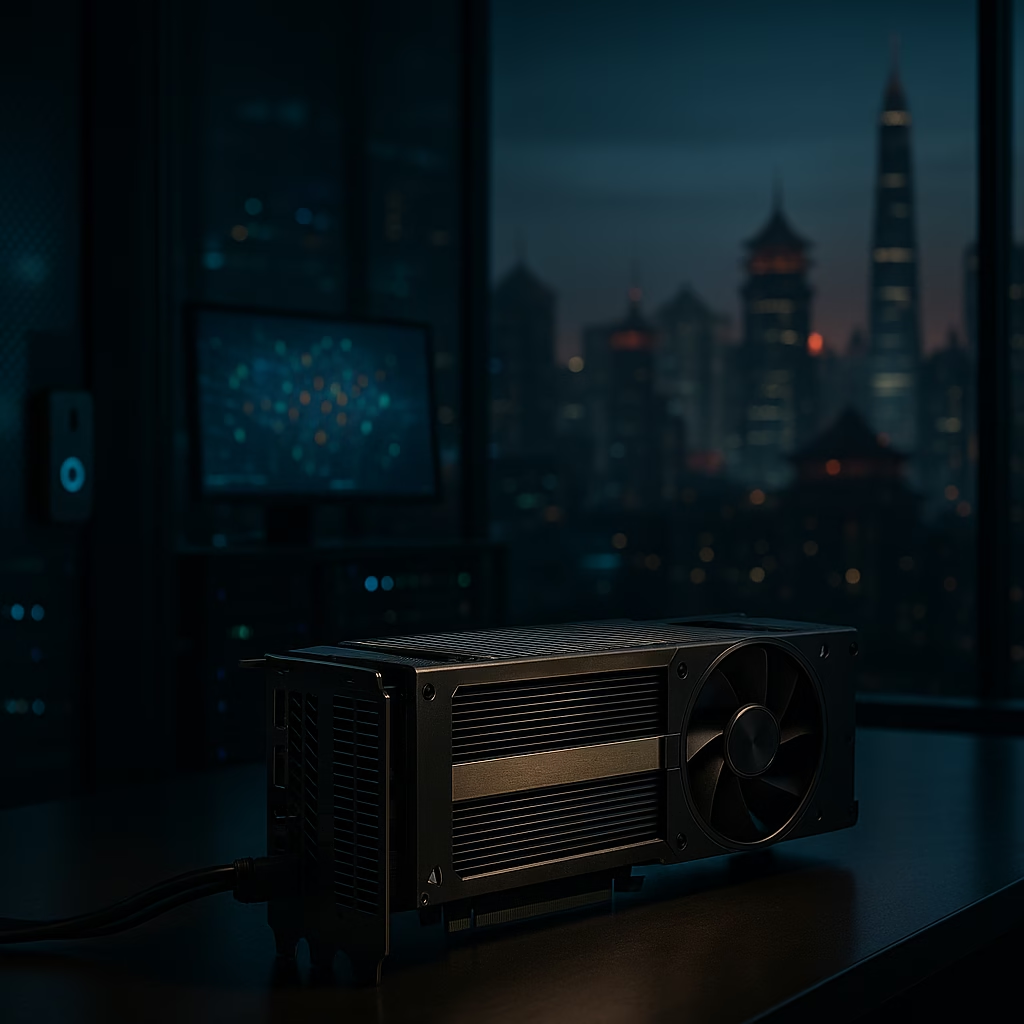
China Weighs Nvidia H200 Access Amid AI Growth And Security
Balancing AI Ambition With Self-Reliance And Control
China’s leadership is confronting a complex decision: whether to allow broader domestic access to Nvidia’s H200 AI accelerators, or to curb their use in favor of indigenous chip development and national security priorities. The question goes far beyond a single product. It cuts to the heart of how Beijing intends to reconcile its desire to lead in artificial intelligence with tightening US export controls and a strategic push for technological self-reliance.
The H200 is one of Nvidia’s most advanced AI chips currently eligible for export to China under US rules. For Chinese policymakers, it represents both an opportunity to keep pace in the global AI race and a potential vulnerability, given its foreign origin and the risk of future restrictions.
Why The Nvidia H200 Matters For China’s AI Ecosystem
Nvidia’s high-end GPUs have become the de facto backbone of modern AI training globally. The H200, a successor to the company’s widely used A100 and H100 lines, offers high memory bandwidth and strong performance for training large language models, recommendation engines, and other data-intensive AI applications.
For Chinese tech firms and research institutions, access to such hardware is critical because:
- AI model training is extremely compute-intensive – Large foundation models require thousands of GPUs and weeks of training time.
- Domestic alternatives are still catching up – Chinese chipmakers are progressing, but performance, software support, and ecosystem maturity often lag Nvidia’s offerings.
- Time-to-market is crucial – In sectors such as generative AI, recommendation systems, and autonomous driving, being months behind global competitors can translate into lost market share and influence.
As a result, the availability of H200 chips could significantly affect the competitiveness of Chinese AI companies, especially those building frontier models or cloud-based AI services.
US Export Controls And Their Ripple Effects
Washington has steadily tightened controls on exporting high-performance AI chips to China, citing concerns over military modernization and dual-use applications. Earlier generations of Nvidia chips, such as the A100 and H100, were restricted, prompting Nvidia to design China-specific variants with reduced capabilities to remain compliant.
The H200 sits in a sensitive space. While configured to meet US export rules, it still delivers substantial compute power. That makes it an attractive option for Chinese companies, but also a focal point in ongoing US-China tech tensions. Any policy change in Washington could quickly alter the availability or configuration of such chips for the Chinese market.
Beijing’s Strategic Dilemma: Access Versus Autonomy
Chinese policymakers must evaluate the H200 question within a broader national strategy that prioritizes self-reliance in critical technologies. Over the past decade, Beijing has rolled out initiatives aimed at reducing dependence on foreign suppliers in semiconductors, software, and telecom infrastructure.
In this context, decisions on Nvidia chip access are likely to weigh several competing considerations:
- Short-term AI competitiveness: Allowing extensive H200 use could help Chinese firms remain at the cutting edge in generative AI, cloud computing, and enterprise AI solutions.
- Long-term domestic capability: Over-reliance on imported GPUs could slow the development and adoption of Chinese-designed accelerators and local software ecosystems.
- Security and control: Dependence on a US company, subject to US law and export decisions, introduces strategic risk if access is suddenly reduced or cut off.
- Industrial policy signals: How regulators treat Nvidia hardware will send a strong message to domestic chipmakers and investors about the level of state backing for homegrown alternatives.
Impact On Chinese Tech Giants And Startups
China’s leading internet and cloud companies—along with a new wave of AI startups—are racing to build large models and AI-driven services. For them, GPU access is a bottleneck. Many have already invested in securing as many compliant Nvidia chips as possible while also exploring domestic accelerators from Chinese vendors.
A more permissive stance toward H200 imports and deployment would:
- Support rapid scaling of cloud AI infrastructure and public AI services.
- Enable competitive performance in foundation models targeting both Chinese and global markets.
- Help Chinese firms maintain parity with foreign competitors that also rely heavily on Nvidia hardware.
On the other hand, stricter controls or informal discouragement of H200 usage would pressure companies to:
- Shift workloads toward domestic AI chips and accelerators.
- Invest more in software optimization and algorithmic efficiency to compensate for hardware gaps.
- Collaborate more closely with local chipmakers to co-design solutions tailored to Chinese data centers and applications.
Domestic Chip Industry: Challenge And Opportunity
China has been pouring resources into its semiconductor ecosystem, from design houses and foundries to packaging and EDA tools. However, high-end AI accelerators remain one of the toughest segments to master, especially under US restrictions on advanced manufacturing equipment and IP.
The policy stance on H200 could either:
- Relieve pressure on domestic vendors by allowing time to mature while Nvidia fills the immediate need, or
- Intensify the push for homegrown innovation by constraining Nvidia’s role and effectively reserving market space for local challengers.
In either scenario, the direction of travel is clear: China intends to reduce its vulnerability to external supply shocks and sanctions by building a more self-sufficient AI hardware stack over the long term.
Looking Ahead: A Calibrated, Dual-Track Strategy
China’s decision on Nvidia H200 access is unlikely to be binary. More probable is a calibrated, dual-track approach that:
- Allows controlled use of foreign GPUs like the H200 for commercial and civilian applications, within regulatory guardrails.
- Channels significant state support toward domestic chip R&D, manufacturing capacity, and AI software ecosystems.
- Imposes stricter oversight on sectors deemed sensitive for national security or military use.
This approach would seek to capture the benefits of advanced foreign technology in the near term, while steadily reducing strategic dependence over time.
Ultimately, how Beijing handles Nvidia’s H200 will be closely watched as a signal of its broader philosophy toward foreign technology in an era of intensifying geotechnological competition. The outcome will shape not only China’s AI trajectory, but also global supply chains, investment flows, and the competitive landscape of the AI hardware market for years to come.
Reference Sources
MLex – China to weigh AI gains with self-reliance, security in Nvidia H200 access decision
Reuters – Nvidia designs new chips for China to comply with US export rules
Financial Times – Nvidia races to redesign chips for China as US curbs bite





Leave a Reply