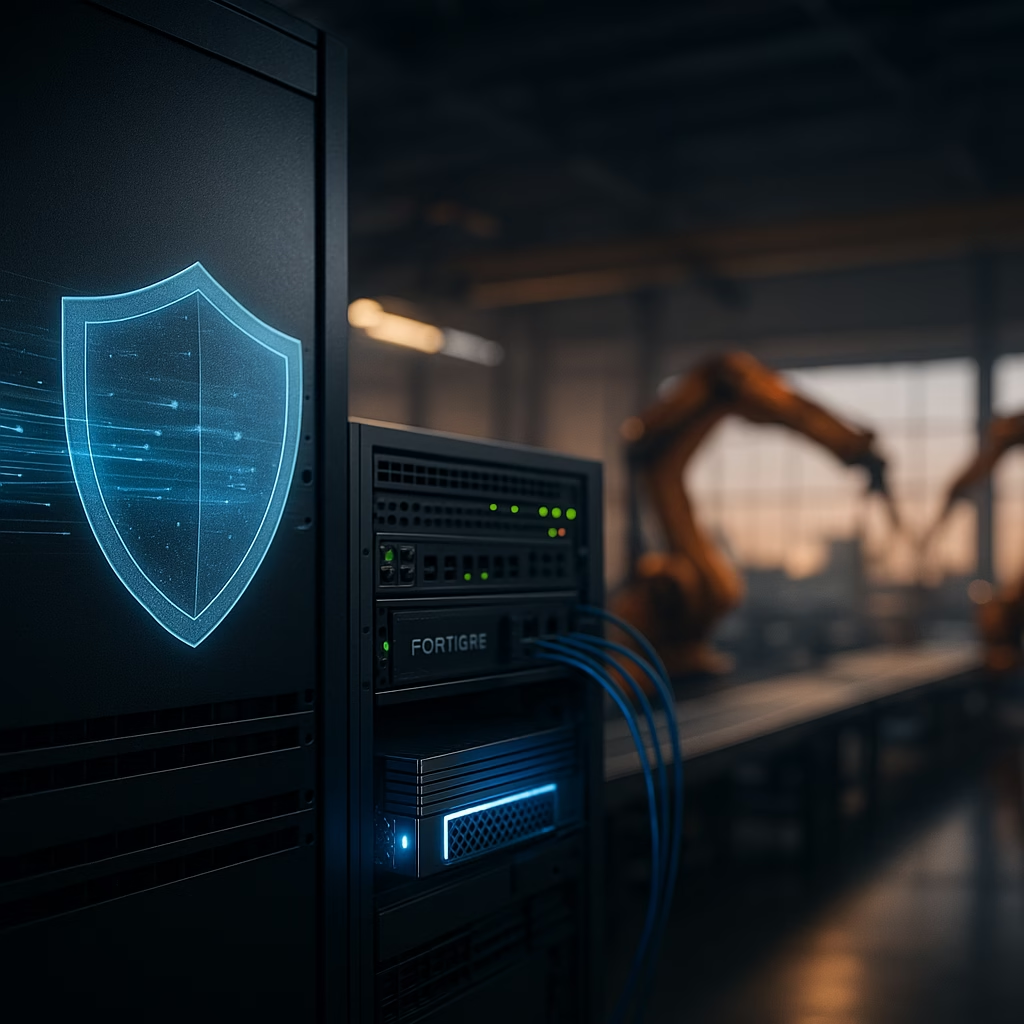
Fortinet FortiGate VM and NVIDIA BlueField-3 Boost AI Factory Security
As enterprises race to operationalize generative AI, they are also building what many vendors now call an “AI factory”—a high-throughput environment where GPU clusters, accelerated networking, and massive east-west traffic come together to train, fine-tune, and run AI models. This shift is creating a new security pressure point: traditional perimeter defenses are not enough when data is constantly moving between GPUs, storage, and microservices inside the data center.
To address this, Fortinet has integrated FortiGate VM with NVIDIA BlueField-3, aiming to improve security performance for AI infrastructure without slowing down workloads. The announcement reflects a broader industry trend: security controls are increasingly being pushed closer to the workload and offloaded to specialized hardware, rather than competing with AI jobs for CPU cycles.
Why AI factories are changing data center security
AI infrastructure differs from conventional application stacks in a few important ways. Model training and inference pipelines typically generate high-bandwidth, low-latency traffic patterns, and they often rely on distributed architectures that multiply internal communication. At the same time, organizations are handling sensitive assets such as proprietary datasets, customer information, and model weights—making AI environments a prime target for attackers.
Security teams face a difficult balance: they must enforce segmentation, threat prevention, and policy controls while avoiding bottlenecks that can reduce GPU utilization and drive up costs. In a macro sense, this is also an economic issue: GPUs, high-speed interconnects, and power are expensive, and any inefficiency in the pipeline can translate into a measurable increase in total cost of ownership.
What the FortiGate VM and BlueField-3 integration delivers
Fortinet’s approach centers on combining its virtualized next-generation firewall (FortiGate VM) with NVIDIA’s BlueField-3 DPU capabilities. DPUs (data processing units) are designed to handle infrastructure workloads—networking, storage, and security—so the host CPU can focus on applications. In AI deployments, that means more compute resources remain available for model training and inference.
By aligning FortiGate VM with BlueField-3, the goal is to provide faster, more scalable security services for AI data centers and cloud-like clusters. The integration is positioned to support:
- Accelerated security processing by leveraging DPU resources, reducing reliance on host CPU cycles.
- Improved protection for east-west traffic inside AI clusters, where lateral movement risks are high.
- Better segmentation and policy enforcement for multi-tenant or multi-project AI environments.
- Higher efficiency at scale, which is critical as organizations expand GPU fleets and distributed training jobs.
This design philosophy maps to a growing consensus in the market: as data centers become more software-defined and AI-heavy, security must become more embedded and performance-aware—not an afterthought bolted onto the edge.
How DPUs fit into modern “zero trust” data center strategies
Zero trust principles—“never trust, always verify”—have been steadily moving from identity systems into network and workload security. AI factories make this evolution more urgent because sensitive data travels continuously between components. DPUs like BlueField-3 can help by providing a more deterministic way to enforce controls in the data path.
In practical terms, integrating a firewall VM with a DPU-enabled environment supports a security architecture where:
- Workloads can be isolated by policy even when they share underlying infrastructure.
- Inspection and enforcement can be distributed without forcing all traffic through a centralized choke point.
- Organizations can pursue consistent security controls as they move AI workloads between data center and cloud-like environments.
This matters because AI adoption is not limited to tech giants. Financial services, healthcare, telecom, manufacturing, and public sector organizations are investing heavily in AI capabilities, and many are building private AI environments to retain governance over data.
Industry implications: security becomes part of the AI performance conversation
The integration also highlights a strategic shift: security vendors and infrastructure vendors are collaborating more closely to match AI-era requirements. Historically, security tooling could be viewed as an operational layer. Today, it increasingly influences utilization, throughput, and workload economics. In AI factories, where GPU time is precious, reducing overhead can be as important as adding new controls.
For organizations planning AI expansions, this kind of integration may serve as a blueprint: combine hardware acceleration with mature security capabilities to maintain strong protection without undermining performance.
Conclusion
Fortinet’s integration of FortiGate VM with NVIDIA BlueField-3 targets a core challenge of modern AI infrastructure: protecting fast-moving, internal data center traffic while keeping AI systems highly efficient. As AI factories become a mainstream enterprise model, solutions that embed security into accelerated infrastructure are likely to gain momentum—helping organizations scale AI with stronger resilience, clearer segmentation, and fewer performance trade-offs.






Leave a Reply